
How can we live with the distress caused by climate change, Brexit and other major world events; with climate change being the biggest challenge to us all?

…My experience is that I have lived with the anguish and distress all my life. It’s under the surface much of the time. Periodically I turn towards it, and simply listen….
What comes is how much sadness and pain is there. Something in me finds it unbearable…
As well as hopelessness, I also sensed and recognised the enormous hopefulness I feel…

Read More

A Focuser says, ‘Sometimes if I Focus on the problem, it just gets worse. Maybe it’s best if I don’t think about it. How does Focusing help?’

It’s true that when you Focus on a problem, it can seem to get worse. This is what I call intensification. What is happening is that when you bring your attention to something, you become more acutely aware of the pain it is carrying.

Read More

A Focuser says, ‘I have been an introverted person, and now I am moving towards looking more outside myself for help and guidance. Would Focusing go against that?’

Outside help and guidance can be enormously helpful and supportive, for instance by giving another perspective when you are feeling confused, or ‘can’t see the wood for the trees’. There may be times when therapy is what’s needed.

Read More

Usually most of us tend to go towards what feels difficult or problematic in our lives, and this is naturally right and proper.

I also wonder how often we Focus with what feels good in our lives.
I suggest that it is helpful to spend at least some time in every session with what feels good. And then to identify and to Focus with exactly how it feels good, and where in your body does it feel good. There are a number of reasons why it is helpful…

Read More

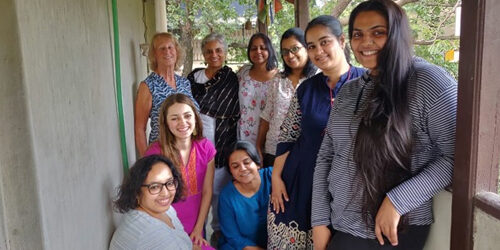
Having returned from a wonderful teaching trip to the Just Being Centre in Pune, India, I want to share a key moment, and what it can mean for your Focusing.

I was demonstrating with a course participant, and after feedback in the group I invited her to share from her perspective.
She said, ‘It is not a technique. Only hearts can do this.’
I was deeply touched and moved. I felt that as a new Focuser, she got it. She understood what it means to listen to herself with kindness and compassion

Read More

Sometimes big, overwhelming feelings can sweep over you, especially if Focusing is new to you.

You can always check with your felt sense, by asking, ‘does it feel OK for me to be with this?’ And then wait and see what comes. Two things can happen…

Read More

Every Focusing teacher develops their own style of teaching, just as every Focuser develops their own Focusing practice, because each of us is unique…

Gene Gendlin, who developed Focusing, said Focusing always ‘crosses’ with something else. It isn’t a standalone practice, because you change it by being who you are. Your personality, past history, current interests and understandings all inform your Focusing practice. I cannot separate myself from my past, my nature, or my way of being. Focusing crosses with who we are.

Read More

Have you noticed how different things come up in your Focusing session, when you have different Focusing partners?

…You are the same person, with the same issues, and yet when you are with a Focusing partner, something will come up for attention, that would not come up with another person as your partner… At the recent Focusing community camp, I had the chance to explore how I feel in relationship with the person I was being a Focusing partner with.

Read More

I have found Focusing has helped me enormously in my work as a therapist.

…You can use Focusing to ground yourself in the present moment, becoming aware of how you are, and what you are bringing to the therapy space. It helps by increasing self awareness, and allows issues to settle, without you being taken over by strong feelings, or needing to push them away.

Read More

I have just come back from the wonderful 1st European Focusing Conference in Loutraki, Greece.

…One of the lectures that inspired me was exploring what is a felt sense, by Mia Leijsson, Professor emeritus of University of Leuven, a research university in the Dutch-speaking town of Leuven in Flanders, Belgium.

Read More